


A conversation does not have to be spoken out loud. Sometimes it can just be a series of looks, two pairs of eyes communicating from across the room, or a hand on your shoulder, telling you that everything is going to be alright. Conrad Tao and Caleb Teicher know this just as well as anybody, for although Tao, a pianist and composer, and Teicher, a choreographer and dancer, have known each other since 2011, some of their best conversations occur without saying a word.
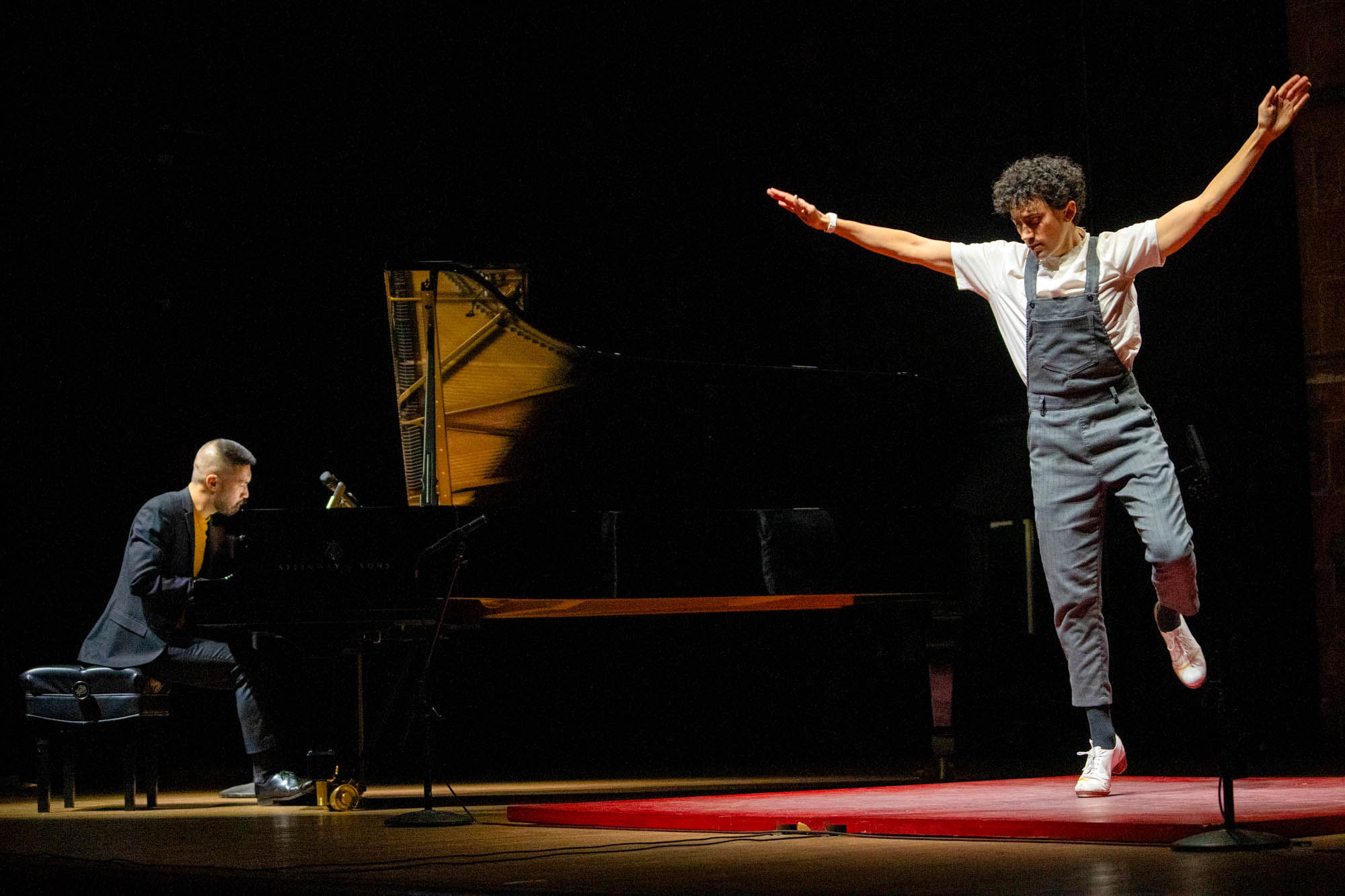
Since 2020, Tao and Teicher have collaborated on Counterpoint, an hour-long program that creates a dialogue between the two performers—Tao behind a grand piano and Teicher atop a 16x16 foot tap dance floor—weaving their artistic practices together through a tapestry of music that includes works from Bach, Gershwin and Art Tatum. “There’s a little bit of improvisation between the two of us, with music coming from the classical tradition and the jazz tradition, which is so integral to the history of tap dance,” says Tao. “It’s just ended up being this fun duo between the two of us where we can explore our different instruments—piano and tap dance—and the different traditions that we emerge out of.”
For Tao and Teicher, the initial impetus to create Counterpoint wasn’t purely creative, but instead logistical. The pair had previously collaborated on More Forever, a Bessie Award-winning and New York Times critic’s pick, which was a much larger-scale program featuring multiple performers and was more technically demanding to stage. Within More Forever, however, there was a seven-to-eight-minute section in which just Tao and Teicher performed together.
Those seven minutes, according to audiences, were pure magic. Soon, people were clamoring for a full hour-long concert featuring just Tao and Teicher—but Teicher remained skeptical. “As artists, it’s sort of our job to be hopeful and optimistic and to dream, but I also feel that it’s part of our responsibility to be doubters. I felt like seven or eight minutes was the max that we should do with just the two of us, but we kept getting requests, so we agreed to try it out,” admits Teicher. “After five years of touring this project, it’s surprised us how interesting and engaging it is, despite the spare elements at play. If someone pitched to me a tap dance-music performance with just two people, I’d say, ‘that’s a bad idea.’ The irony is that we’ve been proven wrong time and time again.”
It turned out that all audiences really needed to see was Tao and Teicher performing in perfect harmony, the stage stripped bare of all extraneous lights, props and performers. Tao and Teicher, after all, are renowned masters of their respective crafts—it’s not as if one needs a light show or a soundtrack blaring in their ears to appreciate a Monet painting.
“Anybody who loves piano, is interested in classical, chamber or rhythmic pianists is going to be blown away by Conrad Tao,” says Elizabeth Doud, The Ringling’s Currie-Kohlman Curator of Performance. “He works with different projects and ensembles and is incredibly sought after as a soloist. It’s the same thing with Caleb—as a teacher, choreographer and performer, they are hitting this peak point in their work.”
The music in Counterpoint is stylistically diverse—bookended by the Aria from Bach’s Goldberg Variations, the performance features classical works such as Arnold Schoenberg’s abstract take on the Viennese Waltz, Brahms’ Intermezzo in E major, op. 116/4 alongside pieces from jazz and tap dance traditions like Noble/Powell/Art Tatum’s Cherokee and David Parker’s Song and Dance, based upon Mozart’s Sonata in A Major. “Counterpoint feels a little bit like a program about our friendship. One of the reasons that it’s bookended by the Aria
from Bach’s Goldberg Variations is simply because the Variations are some of the first music that I ever saw Caleb choreograph to,” says Tao. “Some of the solos that I take are pieces of dance music, like Sonatine: II. Mouvement de Menuet by Ravel and there are pieces that Caleb dances to that are commentaries on classical repertoire. There’s a very intimate, simple story about our relationship within the program, and then by extension, the repertoire reflects the relationship between our two instruments, the differences and the connections.”
Teicher relates the progression of Counterpoint to that of a pupil dilating and constricting. The program begins in a quiet, focused manner, before building up to a point where the two are in conversation with each other, communicating not by voice or sight, but by the keys of Tao’s piano and the tapping of Teicher’s feet. That pupil dilates most fully when the pair performs Gershwin’s iconic Rhapsody in Blue in its entirety in the last quarter of the show. “Rhapsody in Blue is such a famous piece of music, but it’s also a very rangy piece of music and the longest work we perform in the program. All of the other pieces we play are four to seven minutes long and then suddenly we have this 17-minute piece,” says Teicher. “It’s pretty intense for both of us—it feels like the peak of the performance—but then the pupil contracts again and we have this more intimate, quiet ending.”
None of this would be possible, however, without the intense chemistry that Tao and Teicher have as artists. Close friends off the stage, Tao and Teicher use the bond they’ve built since first meeting in 2011 to elevate each other’s performances. Counterpoint, Teicher maintains, is not a show that runs on a metronome. While the set list has stayed the same, there are moments of improvisation throughout the program, shaped by not only how each performer is feeling on the day, but also by the energy of the audience. “Neither of us can see the limbs or digits of the other—in a funny way, the things that are most actively contributing to all the sound and energy, we don’t actually experience that with each other,” says Tao. “It’s a connection that’s happening on an energetic level or across the listening plane. At a certain point, it’s more as if you’re listening for each other’s breathing—having that closeness and connection with someone is one of the greatest pleasures in life.”