


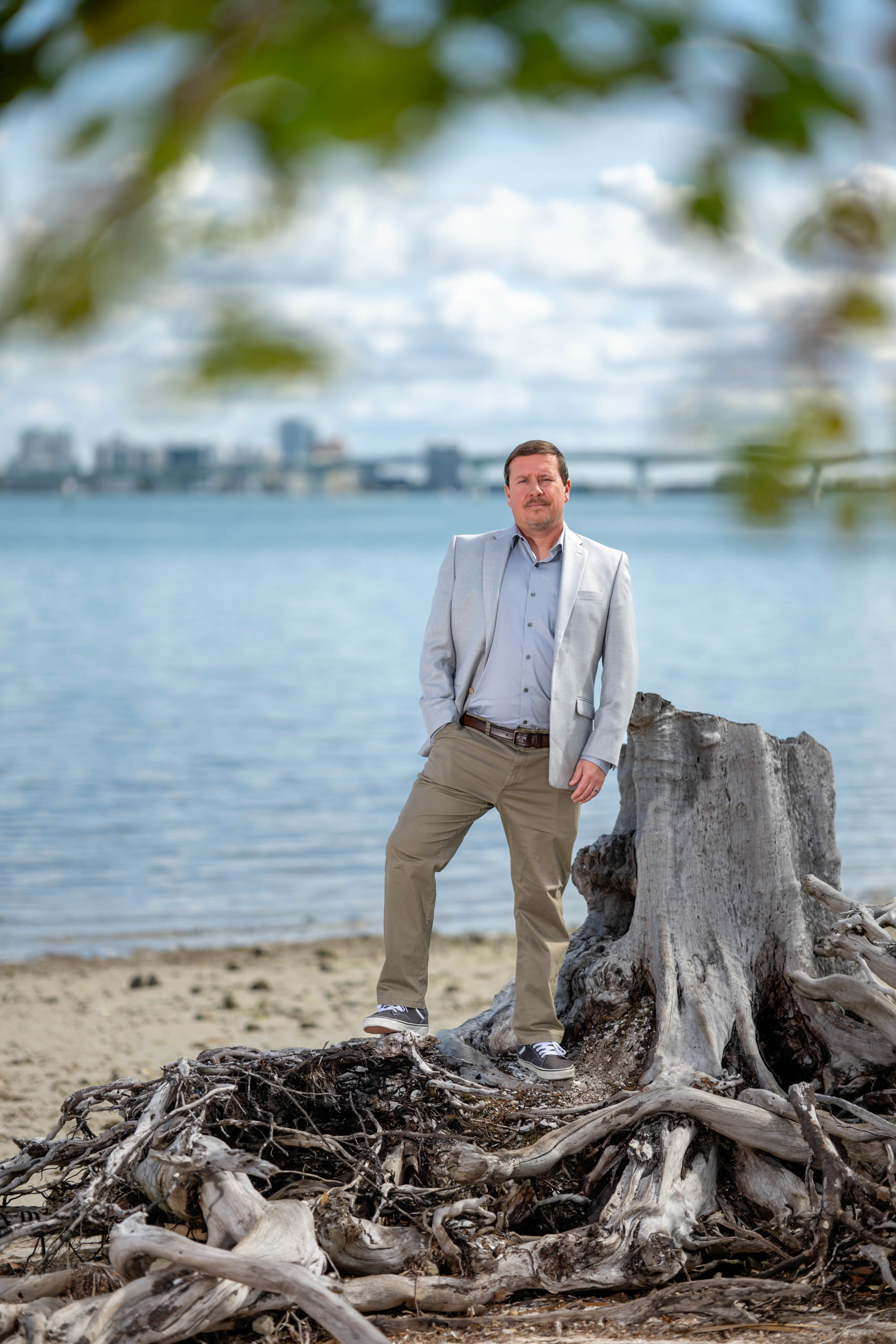
Dr. Matthew Wielicki is not for everyone. But he’d argue, however, that Earth is. Formerly an assistant professor in the Department of Geological Sciences at the University of Alabama and a post-doctoral research scientist at UCLA, Dr. Wielicki veers left where mainstream media turns right. Working from a basis of science and observable data, Dr. Wielicki is an outspoken critic of the traditional models of climate change, arguing against what he views as the “sensalization” of the climate crisis. On January 22, Hoyt Architects hosted Dr. Wielicki as a part of its 2026 Urban Speakers Study Series for his talk Measured vs. Modeled: Climate Data and Design Decisions.
What were some of the focus points of your talk in Sarasota? WIELICKI This is an audience, people in the architecture and design field, that I don’t speak to very often. What I’m focusing on is how assumptions and models can turn into hardcore constraints into building codes and planning designs. What is happening now is that the climate community is focused on the most unlikely scenarios, because those are the scenarios that are the most sensationalized. They create the most publicity, the most clicks. Because of the sensationalization that’s going on, policymakers and planners are taking all of that information as though it’s a likely scenario for the future. We’re seeing very unlikely climate futures that are being hardened into regulations today for future plans that are going to be super costly. We talk about affordability, the cost of housing and construction costs—why do insurance companies pull out of places? People say that it’s because of climate change, but it’s not really. It’s because the regulations that are built in from these climate assumptions mean that it would be impossible to rebuild it to those regulations.
We’re seeing this, for example, in the Palisades and Malibu in Los Angeles. Nobody can build back to those regulations, the septic systems have to be pulled, new pilings have to be put in, because everything is out of code. Instead, you have to focus on getting good data now to make good policy decisions for the future. I try to focus on measurable and observable data. We’ve been collecting data for a long time—the 1990s was when the climate crisis kicked off and everybody started worrying about it. We have lots of satellites and three decades worth of data to mine from. If this was 1996 and the first IPCC was coming out, it would be hard for me to question this, because we didn’t have a lot of data. Now, we have decades of good, global evidence and we’re just not seeing that the original projections for things like the acceleration of sea level rise or island nations disappearing, these catastrophic events, we’re just not seeing them happen. But that hasn’t slowed down the rhetoric, which is spilling into policy and regulation. If we followed that rhetoric in the ‘90s, a lot of the stuff we have today wouldn’t have ever been built. Do we want to do that to ourselves for the future? It’s modeled versus measured—are we going to focus on these climate models, particularly the unlikely ones, or should we focus on the three decades of great data that we have? We tend to want to use these very unlikely climate models and to me, that’s a scary problem.
How has the way in which we collect climate data shifted over time? This is a big deal. The closer we are to today, the better the measurements are, because technology has improved. So 100 years ago, if there’s a hurricane in the mid-Atlantic that never reaches the shore, the only record we had of it were the drunk sailors jotting down that the wind was so bad they could barely get the rum in their mouths. The further you go back, the data becomes far less granular. I go all the way back to things like rock records, sediment records and ice cores. So when people say that this is the most unprecedented change in the last 125,000 years, that’s crazy because if you go back a few thousand years, we just don’t have the resolution to know if things change like they have in the last century.
And you believe that it's hard to use the data now to predict what might happen in the future? It depends. If you look at global satellite data, for example, that looks very different from local data. According to global satellite data, oceans are changing at something like a few kilometers a year. In Stockholm, however, sea levels are dropping 3.6 millimeters per year because the area is still rebounding from the last time that there was a big ice sheet on top of it. You can’t use global climate models for local projections—I tell people that you should focus on what’s happening locally. In certain aspects, yes, the data today is good for predicting climate change, but we’re injecting global climate models into local restrictions and regulations. That’s a problem.
As an area that has been slammed by major hurricanes in the past few years, how would you say that the changing climate is impacting catastrophic weather events? We think of hurricanes as relatively simple. You warm the waters of the oceans and a hurricane gets more energy and becomes more powerful. What we’re seeing is the exact opposite. It’s pretty much uniform that the oceans have warmed, very gradually, almost everywhere on earth. Since 1990, we’ve had good satellites that can measure hurricanes quantitatively, with measurements, instead of qualitatively, as in the number of hurricanes. We group all hurricanes into Accumulated Cyclone Energy—we plot all of the hurricanes that happen in a year and how powerful they are. It seems very intuitive that if you warm the waters, hurricanes become more powerful, they’ll spin longer and be faster. The Accumulated Cyclone Energy has gone down significantly while temperatures have warmed. There is a lot of physics with the creation of water droplets that people didn’t think about and everything is just more complex than it’s made out to be. The models predicted that hurricanes would become stronger and more frequent and we’re not seeing that.
We’ve seen the frequency drop and we know why. Because the poles warm faster than the tropics—which we’re seeing in observational data right now—that means that the heterogeneity, the difference between the warmth at the equator and the cool at the poles, is less. That heterogeneity, the bigger the difference between the equator and the poles, the more energy storm systems have and the more volatile hurricanes will be. If the temperature between the poles and the equator was equal, we wouldn’t have hurricanes. There would be no energy in the system to want to distribute the heat. The headlines don’t focus on that anymore, instead they focus on rapid intensification. Rapid intensification is an artifact of the technology we have now. We can fly planes into hurricanes and drop in sensors, we have satellites picking up hour to hour, minute to minute. We didn’t have all of the instruments in the 1980s, for instance, to do this. As technology advances, we notice new things in the climate system, but if we didn’t have that technology before, I don’t think it’s a fair assessment to say, “This is increasing because we can now measure it.” We can only now measure these things, so of course they’re increasing.
Landfalls of hurricanes in the United States have not increased. Landfalls of Category 3 or plus hurricanes have not increased. Climate change isn’t just a local phenomenon. The Accumulated Cyclone Energy is going down. I give people credit when they make a prediction and it’s a little bit wrong, say an increase in energy is modeled at 10% and it’s 8%. But when you get the directionality wrong—we say something is going to increase and it decreases—there’s a fundamental problem in whatever model you had.