

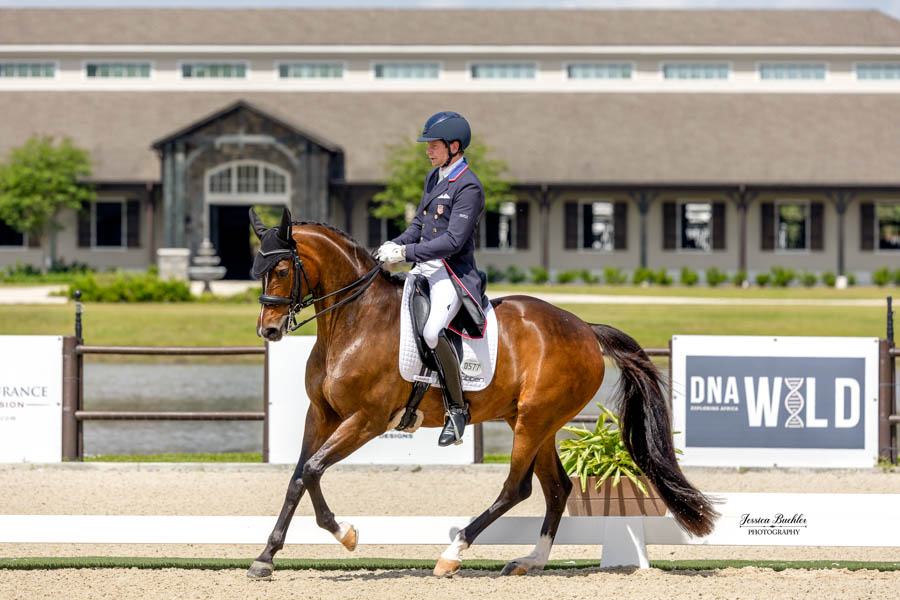
The equestrian sport of dressage is one of power, finesse and harmony. Evolved from military training in ancient Greece, dressage is a form of horse riding that emphasizes mastery over the horse. In this world, Kevin Kohmann stands alone. Born and raised in Germany, Kohmann emigrated to the United States at 18 to train alongside elite riders. In 2014, Kohmann joined Diamante Farms in Wellington, Florida, as a rider and trainer. Since then, Kohmann has proved to be one of the top riders in the sport, representing both Germany and the United States in FEI Nations Cups and competing in the FEI World Cup Grand Prix Freestyle. On May 2, Kohmann competed at TerraNova Equestrian Center in Myakka City, where he topped the leaderboard in the B&D Builders LLC CDI3* Grand Prix Freestyle. Kohmann sat down with SRQ Magazine to discuss his career, the sport of dressage and his relationship with animals.
SRQ: Where did this all begin for you? Kevin Kohmann My mother always had horses and is still breeding them today. I started riding as a young child, when I was 12 years old, and when I was 15 I began riding professionally. In Germany, regardless of what career you choose, whether you want to become a hairdresser or car mechanic or horse rider, you first have to work for a master for three years and then you get something equivalent to a bachelor’s degree. I became the youngest professional rider in Germany with a degree and in 2006, at the World Equestrian Games in Aachen, Germany, I met somebody who said to me, “Hey, do you want a job in America?” I said, “Sure, I don’t speak any English, but I’ll come over.” After my first three years in the United States, I went back to Germany to get my master’s degree and became the youngest master in Germany. A master’s degree gives you a very well-rounded education—everything from dressage to jumping to how to build a farm, horse anatomy and psychology and coaching. In 2014, I started my own business and immediately ran it out of Diamante Farms. I ended up marrying Devon Kane, who owns the farm, and also is a professional rider. This industry and all that it entails, is for crazy people. You kind of need to have somebody in the industry—nobody else will understand what it takes. Since then, I’ve competed in the Nations Cup for Europe, for Germany and for the United States, all over the world. I’ve represented the United States three times in the (FEI) World Cup, which is the top 16 riders in the world competing against each other in a musical freestyle competition.
What does it mean for you to compete at the highest level of the sport? It was always a dream to compete at that level, but it seemed unreachable until I got this one amazing horse. My wife bought this horse when he was three years old and he was supposed to be for her, but he just kept growing and growing. We actually tried to sell the horse, but couldn’t. We called him Denzel. His real name is Dünensee. I took the horse back, competed with him and immediately clicked. We went from a new partnership to World Cup finals within a year.
What does a day of competition look like? It starts by loading your horse and all of the equipment onto the trailer, shipping the horse to the show and setting up the horse’s stall. Normally, you arrive a day before the competition starts. We have a tech room with all of our equipment, including horse food and saddles. Then you have a jog, where you trot the horse in-hand and judges and veterinarians look at the horse and determine if it’s fit to compete. The first day is the Grand Prix test, which is a standardized test, and then people split—some go to the Grand Prix Special and some to the Grand Prix Freestyle. They are two separate classes and competing in them depends on what your goal is. For example, at TerraNova, for me to be eligible to go to Europe and qualify for the World Equestrian Games, I needed three Grand Prix scores and one Grand Prix Special score.
What are the parts of competing that the spectator might not factor into it? How much goes into it. The best rides that you’ve ever seen look very easy, and to make it look easy, it took a lot of time. I know that from the moment a horse is born, so many things can go wrong along the way. To make it to the Grand Prix is a huge accomplishment and to make it to the World Cup finals is insane—only so many people from around the world are going to this competition. To reach that point, you depend heavily on a team—between me and my wife, the farrier, the veterinarian, the massage therapists—so much goes into it. Everybody just sees me in the ring as an individual with my horse, but it’s the teamwork that makes the performance look so easy.
What kind of relationship do you need to have with a horse to be successful in dressage? Because I’ve been working with horses all my life, I’ve had to learn not to get too attached to them. There are lots of times when you have a client’s horse—you don’t own the horse—and the horse is taken away from you, for all sorts of reasons. In the beginning, I try not to get too attached to most horses, but once you start traveling with an animal, even just to a local horse show, you need to establish a certain amount of trust. The horse needs to trust you. It starts with walking the horse onto a trailer—good luck trying to make a three year old horse trust you enough to walk onto a trailer. These are just the baby steps, however.
I’ve traveled so much with my one horse now that after the last World Cup finals, I gave him a month off. The other day, I got on him bareback and rode him out to his paddock. My wife was very concerned about that; she thought he was going to buck me off, but I said, “no, I trust my friend.” He felt that I trusted him not to kill me. That’s the kind of trust you need to have. Everything about dressage was created and based on warfare. Every movement that you do in dressage came out of warfare—when you had to maneuver in battle, you had to move sideways, you had to move from one canter to the other, you had to do pirouettes to spin and find people in different locations—so it began from there, and then when tanks came around, dressage became a royalty sport. Since the sport came from the military, everything about it was very rough and tough, but if the animal doesn’t trust you, then you will never ride a great test. All of the top riders in the sport have learned that and now have started to pay more attention into creating a great partnership with the horse. You can’t do this successfully without that partnership. I’ve always loved horses, but it was this one animal that showed me the way and changed how I am with other horses. I’ve started giving animals a lot more chances, there are lots of horses that are just misunderstood. SRQ