

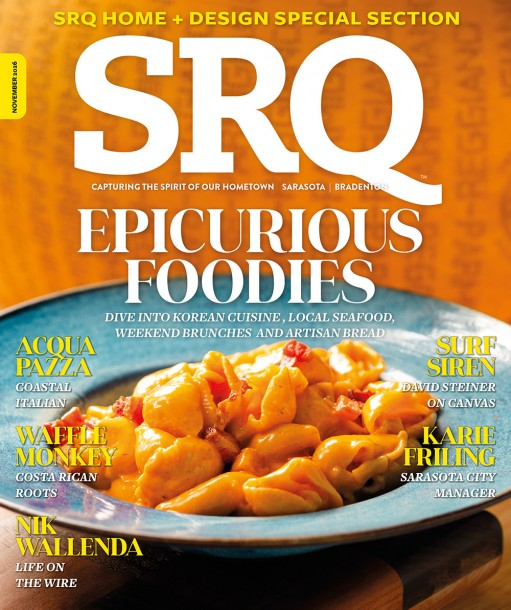
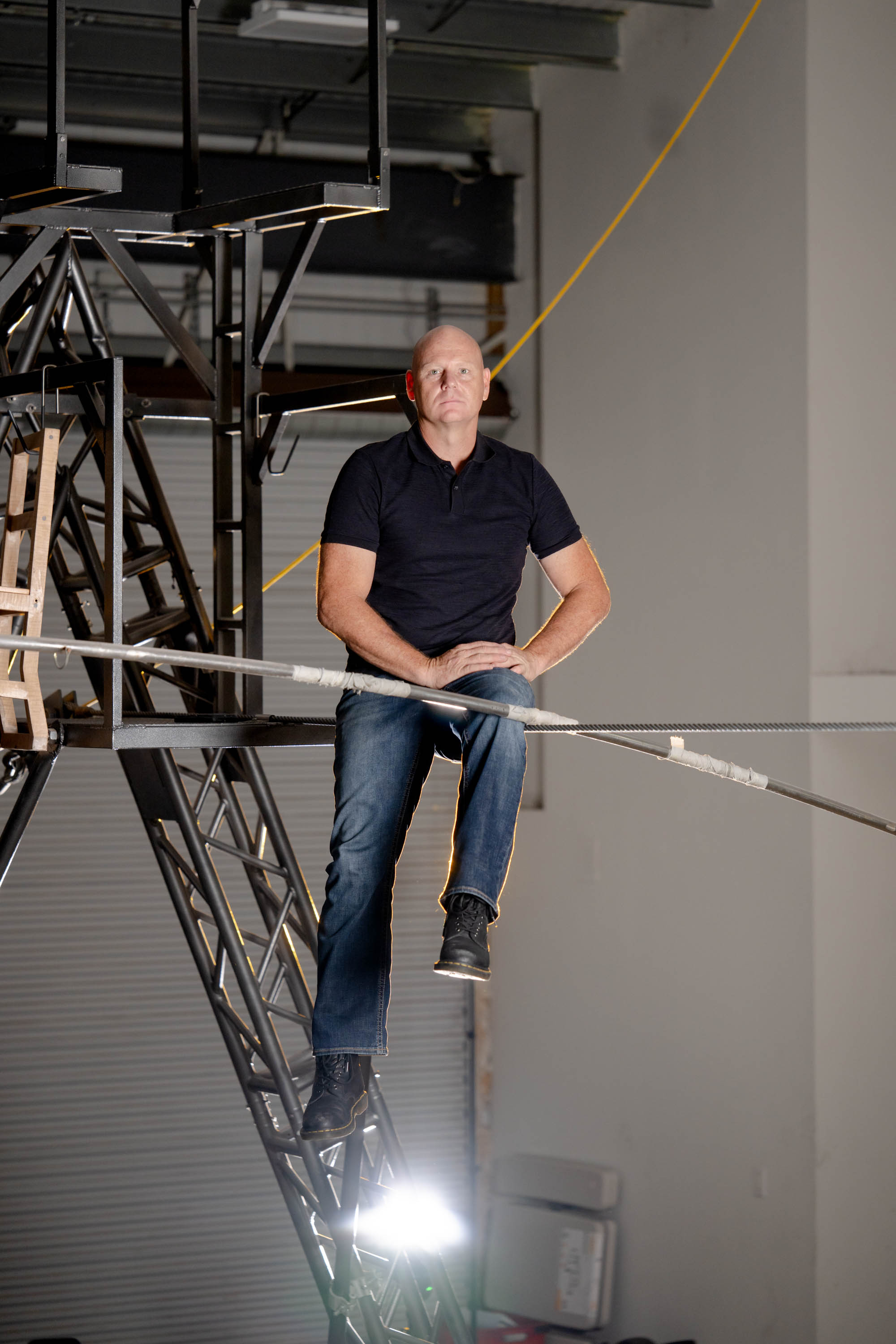
For seven generations, the Wallenda family has dared to do what others deemed impossible. The Flying Wallendas—as coined by the press in the 1940s—began with circus roots dating back to the late 18th century, came to Sarasota in 1927 with John Ringling, when the businessman brought the Ringling Bros. and Barnum and Bailey Circus to the suncoast. Nearly a century later, Nik Wallenda has continued to carry out that legacy. The “King of the High Wire,” Wallenda is a multi-time Guinness World Record holder, known internationally for death defying stunts such as crossing Niagara Falls and the Grand Canyon on a tightrope. Wallenda, along with his wife, Erendira, is also the producer of Nik Wallenda’s Wonderland Circus—now in its fourth year in Sarasota—a part owner of the Big Apple Circus Group and a motivational speaker. The Sarasota native sat down with SRQ Magazine to discuss mental fortitude, life as a performer and what the future holds for the Wallenda family name.
SRQ: You’ve spent your life in the circus. You’ve spent your life as a performer. What still drives you to perform? NIK WALLENDA I say this a lot, but my great-grandfather said, “Life is on the wire. Everything else is just waiting.” And for us, as a family, it’s like you getting up every morning and brushing your teeth and putting your clothes on and spending your day doing whatever. What we do is everyday life to us. I wouldn’t know any other way to live. I absolutely love performing. I love entertaining, but more so I love inspiring. That’s where I found my purpose. I think we’re always looking for, “What’s our purpose?” I’ve learned that what I do often inspires people, especially when I’m pursuing these crazy dreams like Niagara Falls, the Grand Canyon, those sorts of things. Those acts inspire people to pursue their dreams, even though they may seem wild or impossible, or people around them or themselves have told them that it’s not possible. It’s not going to happen. The joy that I get out of what I do is that I get letters, emails and social media messages from people that say, “You know what? When you walked across Niagara Falls, it inspired me. I wanted to run a triathlon. So I knew that even though it seemed impossible, with what you did, showed me I could do it.” It’s what drives me to continue to do what I do.
Every show that we produce, Wonderland, we always say we’re “a circus with a purpose,” because there’s a message behind it, a message of inspiration. Generally, there’s a character that’s overcoming some challenge of some sort. And again, that’s where I get my fulfillment. Hopefully, we people come to Wonderland, or when I’m speaking to them, they’re forgetting about all the challenges they’re facing. Do I love being on the wire? Absolutely. Do I love performing, entertaining? Yes. Do I get a rush? Very, very rarely. It’s not about that, a rush. I believe that I’m fulfilling my calling. When you’re doing what you’re called to do—well, it’s joyful, for sure.
You’ve told us before that, “The most valuable lesson I’ve learned in my life from walking the wires is that we’re in control of our thoughts. They are not in control of us.” Are there times where that’s been particularly tested throughout your career? Or is it a constant battle? All the time. In every walk of life. When I’m getting ready to go on stage and speak to a group of people, it’s not like I’m immune to that. It’s funny. People think, “He walks a wire. He’s fearless.” No, I’m far from it. Fear tries to take control of my thoughts before I go out on stage and talk to people. What I’ve learned is that I can redirect my thoughts. I can stop them in their tracks. I will tell you, it is a daily struggle in all sorts of walks of my life. I mean, as a producer, you’re always worried about selling tickets. It costs a lot of money to do Wonderland, well over seven figures. It’s a big risk. I talk about in my second book, Facing Fear, where my family struggled as “starving artists” just like most artists do. They went bankrupt, because of that, finances are probably my greatest fear. It’s frightening sometimes—“oh my gosh, I hope we sell enough tickets”—for me, it’s about breaking even. I pay my bills by corporate speaking and doing these big walks, but Wonderland is kind of a gift to Sarasota. Once I break even, I can breathe. We don’t always break even, but we’re giving something back to a community and, again, using our gifts to inspire them. But as far as controlling your thoughts, it is literally a constant battle of, “Oh my God, we’re not going to sell enough tickets,” and then I’ll be like, “No, don’t even think that way.” You can’t change the future, so don’t try to predict it. We worry about things that might happen that rarely ever happen more than anything.
When it comes to wire walking, it is, “No, I’m not going to focus on the fact that I could fall. I’m going to focus on the fact that I trained and if I do fall, I can hold on and wait for help.” I’m not going to focus on the strong winds. I’m not going to focus on the fact that they’re going to knock me off. I’m going to focus on the fact that I trained in 90-mile-an-hour winds and they couldn’t knock me off. Our minds are so powerful. I truly believe that anyone can accomplish anything, without physical limitations, obviously, that they set their mind to. It’s just mind over matter. Do I want to be a doctor? Do I want to be a scientist? Do I want to be an astronaut? I can do any of those things. It’s our minds that tell us, “No, you can’t do that. It’s not going to happen. Not possible.” We then have to say, “No, I’m in control here. Who says I can’t?”
What do you hope the Wallenda name will represent 50 years from now, given all that you do from speaking engagements to producing circuses such as Wonderland to performing? My passion is inspiring, and I hope that through what I did, I inspired the next generation. Either the next generation of circus performers or the next generation of circus fans—that’s a big passion of ours—is how do we reinvent an age-old industry? How do we take something that is sort of in the past, that is almost looked negatively upon because the next generation doesn’t necessarily understand it 100%, and they’re like, “Oh, it’s the circus. I’ve heard about it. I’ve seen cheesy stuff in cartoons, I don’t want to go be a part of that.” One of the greatest challenges my wife and I face is how do we reinvent the wheel? How do we make it exciting and entertaining for the new generation who is TikTok, swiping constantly? Wonderland is certainly Broadway, circus and American Ninja Warrior combined. Our goal is to tell a story through what we’re doing and keep every generation entertained, which gets harder and harder with social media.
With Wonderland, how do you kind of balance spectacle with telling an emotional story? What comes first, the story or the stunts? To give insight on the business side, we are struggling with that. The current administration, obviously, has closed all its borders, and a lot of the greatest talent in the world comes from around the world. Obtaining Visas to get the great talent that we want is very difficult. In fact, we have had several already denied—an act was coming from Ukraine, we have another from somewhere else that doesn’t look like it’s going to happen. What makes it even more challenging, is that we write the story first. As we write the story, we’ll go, “Remember when we saw that show in Germany and saw that act? That would go perfectly right here.”
Then we’ll contract these acts—I’ve already signed contracts with acts from outside of the country for the 2029 season. However, Visas aren’t issued until three months prior to the travel date. Last season, my wife had made costumes for seven performers, edited their music, written their storylines, when their visas were denied within seven weeks of the show’s start. We then had to rewrite those storylines with the new talent that we’d found inside of the U.S.
Those are the challenges that people don’t see, but it always works out. That’s an analogy I use in life—even in the worst of times, it’s made me a better person, so it always works out. Even when I’m in that valley—and they’ve been as dark and deep as you can imagine—I always think to myself, “OK, I’m in this valley for a season, but this season will end and every valley I’ve been in, that season has ended.” People continue to come to Wonderland. This is our fourth season. It certainly is becoming a family tradition for many in this area. We believe that it’ll continue to grow. My plan is that my kids take this over and in 50 years from now, it’s still going on.
What does Sarasota mean to the Wallenda’s? We moved here in 1927. We lived in the Ca’ d’Zan with John Ringling for a couple weeks during an offseason. Because I travel so much, this is—people say, “Where’s your favorite place to vacation?” It’s home. One, we have an amazing beach. We have an amazing community. But it’s being home. I promote this city like crazy. No matter where I go, I’m talking about Sarasota. No matter what television special or network I'm on, there’s parts that are featuring Sarasota. I’m working on a deal with Netflix, which I can’t divulge the specifics of just yet, but there’ll be a segment on Sarasota. People don’t like that I always promote it, because we are becoming more and more crowded. Traffic is getting worse and worse. We obviously need to upgrade our infrastructure in a huge way. However, I’ve traveled again around the world and my favorite place to be is Sarasota. People always say, “Why don’t you live in LA? Why don’t you live in New York?” Because I would not want to live in New York or LA. This is home for me. This is the greatest place to live. SRQ