


The Bakero
By sunrise, bakers across Sarasota have been awake for hours.They’ve worked the dough, checked their starters, silenced one timer after another. Three hours in, the deck ovens throw enough heat for the first batch. Steam rolls out when the doors open, and the aroma of fresh bread fills the bakery. M.F.K. Fisher, the influential American food writer, called that smell “indescribable in its evocation of innocence and delight.” Loaves emerge golden brown, ticking as they cool. Before commercial yeast appeared in the nineteenth century, bread began with flour and water left to ferment; wild yeasts and naturally occurring bacteria made it rise. Egyptians baked like this around 1500 BC. Gold Rush miners helped make sourdough a San Francisco habit. In 2010, Chad Robertson’s Tartine Bread handed the artisan bread movement a blueprint: natural leaven, barely handled dough, long fermentation. The ideal loaf emerged with a crackling crust and an open, custardy crumb. Sixteen years later, people want sourdough more than ever. The bakers that local folks ask for by name are making it in small batches, by hand, because they can’t help themselves.
Owner and head baker of the newly opened The Bakero, Natalia Lugowska, learned her craft in Warsaw before moving to Sarasota in 2024 with her family. Years of experience taught her that “it’s difficult to have everything under control.” A proof answers to any number of things, not to a clock, so she adjusts her morning to whatever the dough is doing. “Sometimes it’s ready today faster than yesterday, so you need to react,” she says.
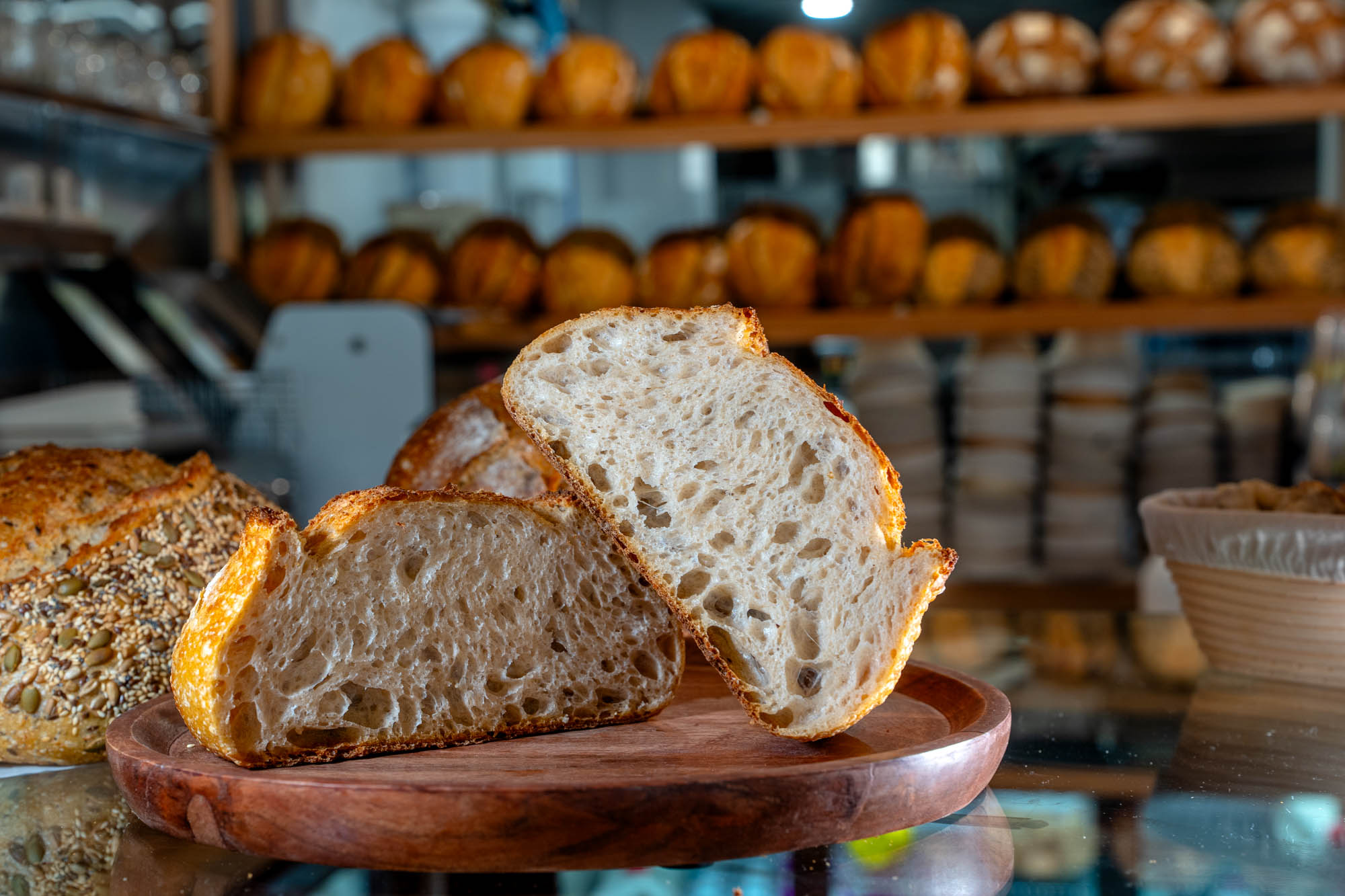
The most important factor: all-organic flour, she says, which keeps out glyphosate, a.k.a Roundup, which Florida testing found in most supermarket loaves. She settled on Central Milling Company in Utah. Her fermentation takes three or four warm hours, then some nineteen in the cold. “The gluten develops for so long. It helps the bread to be very easy to digest,” she explains. High hydration and steam off the oven’s hot stone crisp the crust without hardening it. “It’s very similar to how our grandmas were making bread in a stone oven.” Slice a loaf and the crumb webs into pockets. Bite the heel for crunch, then take the long chew. It’s the lightest of the three breads here, great for tearing, though it toasts up beautifully, too.
The Main Street cafe offers a classic white, a whole-wheat, a five-seed of sunflower, pumpkin, flax, sesame and poppy, a baguette with a crisp golden shell and a bread of the week. Order the Bakero Plate and the sourdough becomes the centerpiece of breakfast: whipped European butter, an organic soft-boiled egg with a runny yolk, aged gruyère, half an avocado, a scatter of flaky salt, plus ham or smoked salmon. It’s continental-style breakfast at its best, and a clear expression of Lugowska’s vision: simple quality ingredients, prepared carefully, with bread at the forefront.
The bakery opens at half past six and closes at two. Lugowska starts at four or five and finishes when the doors do. “The most important thing for me is to have a nap after work, and then I recover and continue my day,” she says—a baker’s schedule summarized in one sentence.
Bread Bandits
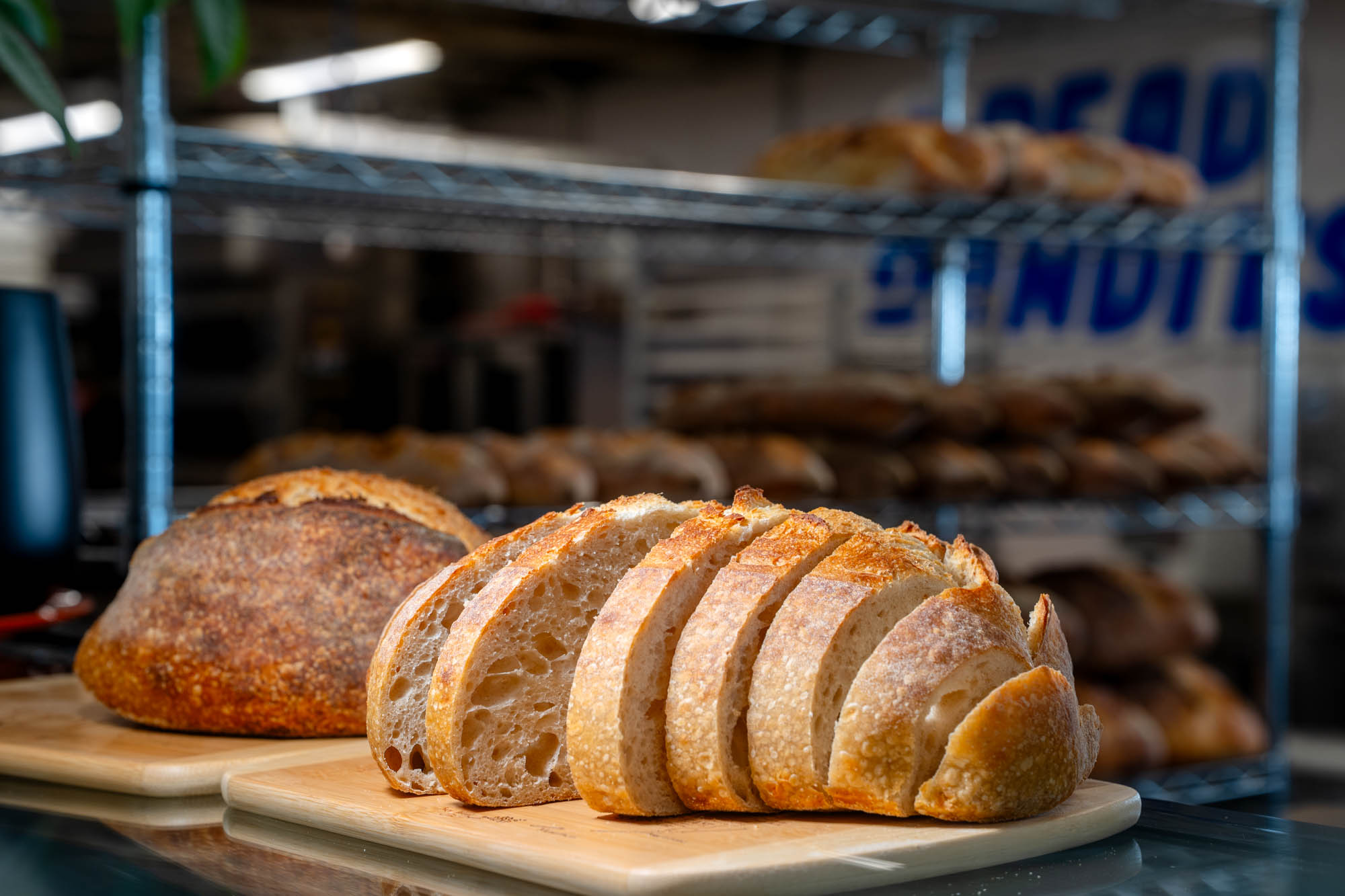
You have likely eaten the bonny loaves of Bread Bandits, since they supply the St. Regis, Indigenous, Pura Vida and other kitchens around town. Jules Thuet is a sixth-generation baker in his family. “The first part happened over a hundred years ago,” he says. His father moved from France to Canada, toting the family starter, out of Alsace, which is more than a century old. Jules brought it south. “I smuggled it down here. To keep it alive. Much like wine, our sourdough, it’s like a terroir.” His business partner, Brad Rutledge, came up through the Thuet family bakery and rose to head baker, then took the same post at Blackbird in Canada. Jules made the pitch: “These people, they want good bread. Let’s bring it to them.” So Rutledge packed up his life, too. Bread Bandits uses Bagatelle flour from Moulins Foricher, an independent family mill that strictly sources and grinds its grains in the Loire Valley. Thuet likes it because, as he puts it, this terroir produces high-quality, sustainable wheat certified under French CRC standards, and that character shows up in the loaf with a creamy flavor and soft, open interior. Filtered water, sea salt, flour, starter. Zero yeast, a point Thuet makes passionately. “Tons of people say, this is sourdough bread, and then you look at the ingredients, and it has yeast,” he says. “In France, they would put you in prison for that.”
The dough ferments for thirty to forty-six hours. “People started introducing machines, and these profit-driven methods, which sped up the process,” Thuet says, sacrificing the time needed for the bread to predigest itself. “That’s what sourdough does. It’s breaking down a lot of the things naturally, and turns into a completely different product. It’s easy to digest and also has tons of beneficial nutrients.” The menu shows hydration figures like a wine list shows vintages: multigrain, seventy-one percent; rye, sixty-nine. Baguettes are seventy-three percent, the backbone of the popular Tuna Bandit sandwich with tarragon aioli and crispy onions. “We filter our water of all chlorine and PFAS [per- and polyfluoroalkyl substances, or “forever chemicals”]. But the natural minerals left that we have in our Sarasota water make incredible bread,” Thuet says. “The NYC water myth has gone too far! Great bread can be made on the Gulf Coast. Crediting water for people’s bread would be the same as crediting the ball for a Messi goal.”
Specials rotate daily: cranberry walnut, challah, potato cheddar, olive-rosemary. There are even sourdough croutons. The multigrain is Thuet’s own pick, thanks in part to twelve hours of toasting before the grains ever meet dough. “Other loaves, they’re just throwing birdseed in there. There’s no flavor added, and it actually soaks up a lot of water. Whereas ours has a beautiful, nutty, toasted flavor.” Every slice feels indulgent as much as virtuous, so you go back for another whether you care about fiber or not. Walk into Bread Bandits on South Osprey seven days, or visit the Venice and Lakewood Ranch markets. A second location recently opened in Lakewood Ranch, with a pastry test kitchen, so they can expand their offerings.
Camelot Breads
Down on Swift Road, in a plaza you would drive past a gazillion times without braking, Michael Toporowski of Camelot Breads works behind a two-century-old dough trough he found in a small town in Provence. The owners declined to sell.
“As long as you take out enough money, things can happen,” he says. Fifty loaves’ worth of dough can rise in that wooden hull at a go, then two people can lift it by the handles and flip the mass onto the table. “This is the way they used to do it,” he says. A flaxseed linen cloth, also a callback of hundreds of years, covers the dough without sticking.
Toporowski came to this late, with intention. “I retired from banking at 55, sat around for a couple of months, my golf wasn’t very good, so I decided to go back to school and got a culinary degree,” he says. He wanted to see how commercial kitchens operated, and to learn the correct methods for safety and scaling up. Every year since, he has taken a class from another master baker. “Here I am, an old student. But you find your passion, you find your dream, and that’s where you go.”
Bread here starts with the mill. In the front room sits a stone flour mill, made in Ukraine on the German pattern, crickety and loud as it works. Stone grinding treats the grain gently and keeps its nutrition intact; the mill handles fifty pounds in half an hour and sifts to any grade from fine to coarse. Ancient grains—spelt, einkorn, kamut, sprouted Red Fife—come from Central Milling. Rye berries arrive from Jack Melton’s family farm near Dade City. “We try to incorporate all the grains,” he says, handfeeding the hopper while flour spills out below.
Today’s starter comes up white, glossy and bubbling, fully alive and ready to work. With digestion in mind, he aims for a total acidity near four, and fermentation lasts twenty-six to forty-eight hours. “We want the bread to be fermented enough that when you eat it, the digestive process has already started enough.” Hand-mixing the dough, he talks structure. “Flour has a disulfide bond,” he says. “The gluten structure when it forms is long and stringy, so if we use a mixer, we’re going to break that bond. That’s similar to taking a pane of glass and shattering it, and then trying to put it back together. You’ll have a bunch of little pieces.” The stretch-and-fold method keeps the network intact, opens more surface to the yeast and bacteria and evens the temperature through the mass. The dough holds enough water that the loaves go straight into baskets afterward. Leave them on the counter and gravity interferes.
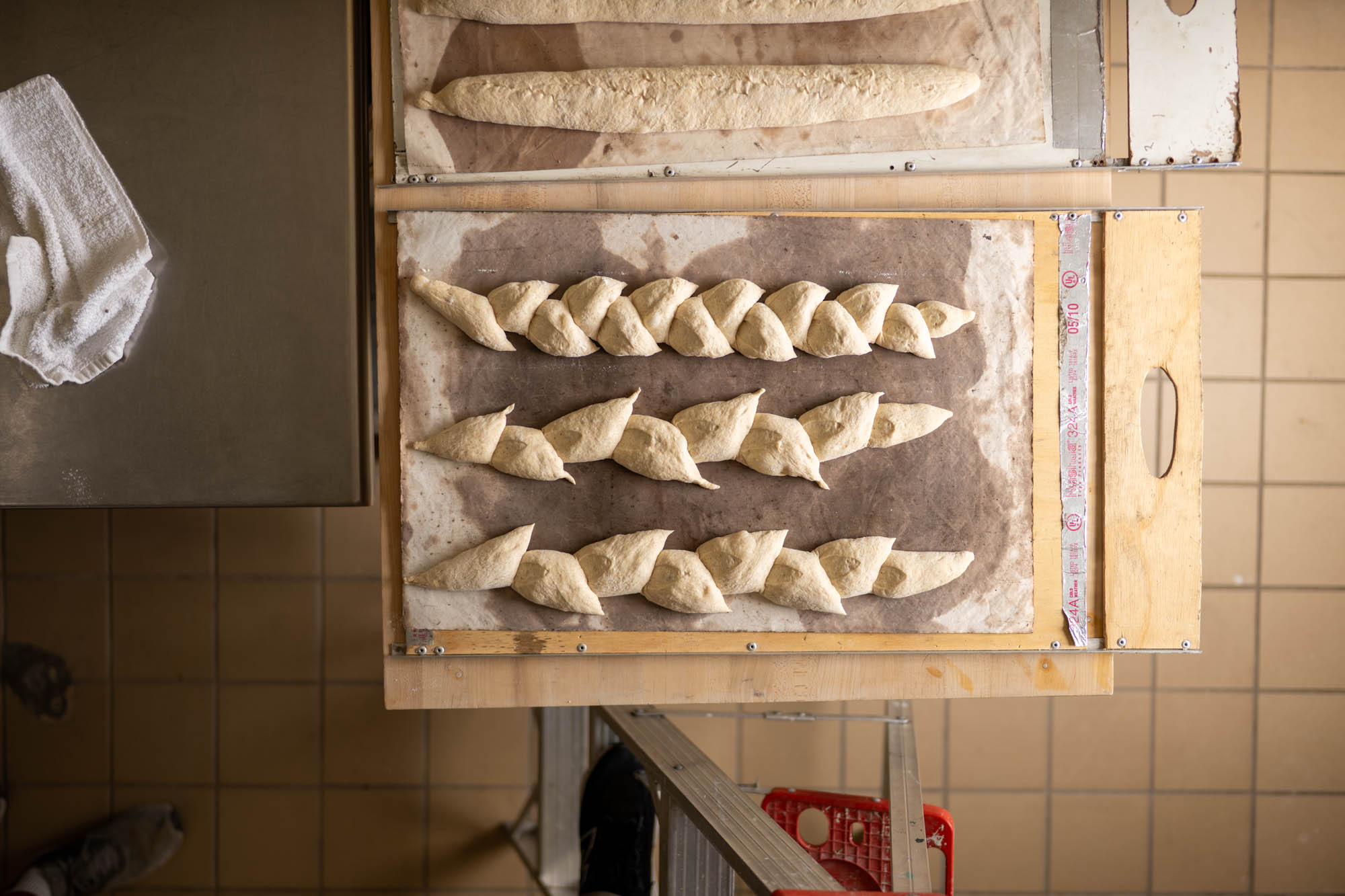
Camelot’s miche follows Poilâne’s lead, one massive country round (3kg, 9 to 10 lbs) that he portions into quarters, its flours—organic wheat, spelt and rye—milled on baking day. Toporowski scores the dough so the wheel won’t tear as it rises. The crust comes up very dark, then gets dusted through stencils so each loaf gets marked with diagonal stripes, wheat fronds or whatever holiday pattern is apt. The miche eats like a robust table bread, dense and husky with a mild sourness that stands up to stew, yet never heavy. It also makes a terrific ham-and-cheese—or croque-monsieur, if you will.
Multigrain—wheat and millet to flax and barley—comes out with a nubbier crumb, gently tangy. Toporowski bakes a shelf of ryes, one with sauerkraut. There’s an epi scored so it tears apart into rolls. “Little buns ready to go,” he says. The focaccia emerges with whole rosemary sprigs, sea salt and good olive oil, a masterpiece he insists anyone can manage at home. “You just get it in your hands, and you want to play the piano to stretch it out.”
Nothing leaves Swift Road for a supermarket or restaurant. Saturdays, Camelot sets up at the Sarasota Farmers Market; Sundays in Lakewood Ranch. Miss both, you wait a week. And yet people do wait. In season, the line wraps around the block, and Camelot produces 1,000 to 1,200 loaves a week. For a baker working this way, the demand tells you plenty. “There aren’t many people doing this sort of thing around town,” he adds.
Long fermentation does what these bakers claim. Phytic acid breaks down so more iron and zinc reach you; bacteria consume the carbohydrates that cause bloating; blood-sugar climbs more gently after a meal. Most supermarket sourdough skips that process entirely. Commercial yeast manages the rising in an hour or two, and vinegar or citric acid fakes the tang. One taste reveals the difference. SRQ