

Spinning Straw Into Gold At The Ringling Museum
Arts & Culture
SRQ DAILY FRIDAY WEEKEND EDITION
FRIDAY FEB 13, 2015 |
BY PHILIP LEDERER
Entitled “Re:Purposed” and featuring found object installations from international artists who transform the unsuspecting into unconventional, the Ringling Museum’s latest high-concept exhibit asks the audience to explore the roles of the objects in their lives - how the object can inform or even define the individual and vice versa - all within the broader themes of environmental consciousness and personal identity. Varied, complex and thematically rich, each installation offers a different approach to the significance of these objects, but from such grand complication, somehow - counterintuitively – the singular essence of each component arises, resulting in a layered and rewarding encounter.
“This is an investigation of how artists are making use of the history of the art and the issues that can be investigated,” said Matthew McLendon, curator of modern and contemporary art at the Ringling, referring to the history of found objects in art from Duchamp’s 1913 “discovery” to today, in a society still grappling with materialism and class. “We don’t only cast off objects, people too.”
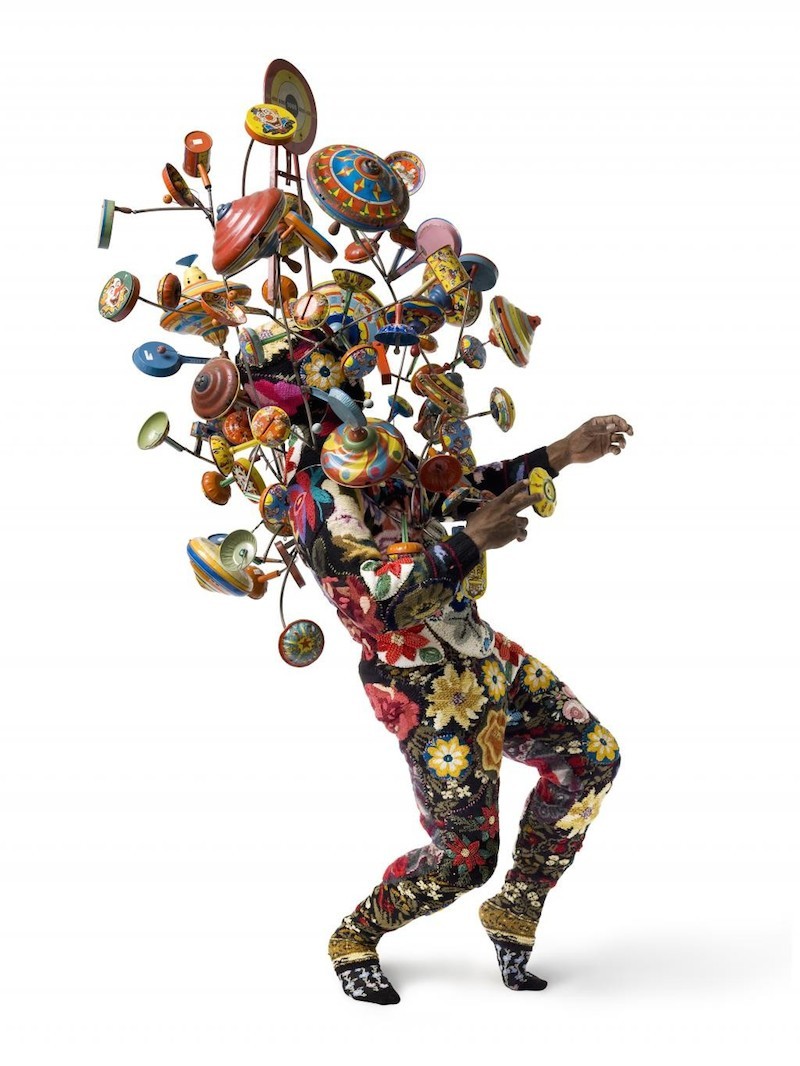
Entering the first room, one is greeted by artist Nick Cave’s “Soundsuits” – full-body suits constructed of and extensively adorned with found objects, such as tin toys and doilies. The human form is all but obscured, allowing the wearer to disappear into the identity of the objects themselves. A great blue-green installation from Aurora Robson hangs from the ceiling nearby. Composed entirely of discarded plastic bottles - shredded, curled, looping and looking like some floating alien jellyfish – a pleasant aesthetic evokes darker conundrums.
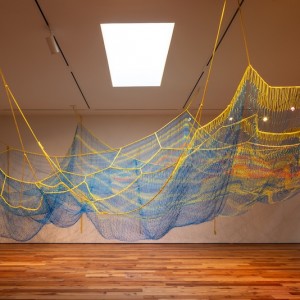
Similarly, the work from internationally acclaimed Ghanan artist El Anatsui beguiles with beauty before packing a punch. The woven textures, earthen colors and geographic form evoke a natural serenity, but closer examination reveals the piece to be constructed entirely of aluminum foil from discarded liquor bottles and copper wire.
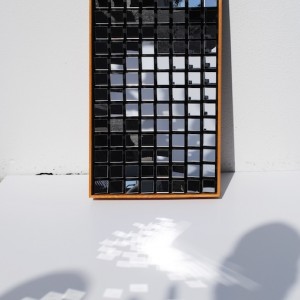
Artistic ingenuity reigns supreme within the gallery walls, from Daniel Rozin’s “Trash Mirror No. 3,” an interactive installation made of 500 motor-mounted, flattened pieces of trash such as cans and cardboards, which flutter and cascade to mirror the form of the viewer (with the help of a cleverly disguised camera), to Alyce Santoro’s tapestries and clothing crafted from abandoned audiotape. Rumors say that with the right equipment, you can still hear the ghosts in the weaving. (Tip: The Ringling has the right equipment.)
The work of Emily Noelle Lambert dominates the following room, her painter’s background clearly evident in the colorfully adorned compositions. Her largest work, “Curio Logic II” spans nearly the entire wall, a vast collage of vibrant forms. Each piece could stand alone, but the interplay of the group – the push and pull of the eye – elevates the whimsical to earnest. “I wanted to make this immersive experience with painting,” said Lambert. “This dimensionality, this playful curiosity.”
In the final room, Ringling Museum artist-in-residence Jill Sigma is working on “Hut #10,” a shelter built entirely of refuse collected from the host community - in this case, all of Sarasota – and the latest in an international series of installations. “There was a constant stream of waste and it sensitized me to these issues,” said Sigman, of the overt environmental context. “This stuff all comes back to us.”
On display at the Ringling Museum, “Re:Purposed” runs until May 17.
« View The Friday Feb 13, 2015 SRQ Daily Edition
« Back To SRQ Daily Archive