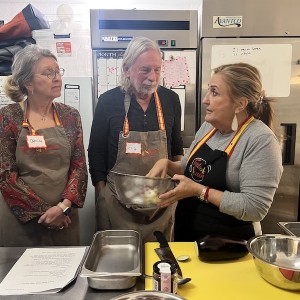



Gamble Creek Farms is a place of stories. It tells the story of proprietor Ed Chiles’ development into more and more environmentally conscious operations, of caring for more than just what goes on his tables, but of the entire ecosystem. It’s a story of wild hogs and papayas, of permaculture, agroforestry and ecological succession. It’s a story of farming truly sustainably, with an ear to the land instead of an eye on the market. The story of Gamble Creek Farms in many ways mirrors the story of natural Florida—of what it once was, of a history marked by land development and a path toward a greener future.


Situated on Manatee County’s Gamble Creek, the 26-acre Real Organic Certified farm was an orange grove for over 40 years before morphing into a community sustainable agriculture (CSA) program. In 2013, the Chiles Group—former owners of Manatee County restaurants the Sandbar, the Beach House and Mar Vista—began to lease the farm as a means to creating a more sustainable culinary ecosystem, providing local produce to and processing waste from its restaurants. “There initially was a culture shift in our restaurants,” says Chiles. “We started composting everything off the plates in our restaurants and using it to build soil, and then got more and more into layers of the process. We didn’t want to just be 50% organic, we wanted to be 100% organic, and rebuild the nutrition of the soil that had been degraded from being an orange grove.” In 2021, Chiles bought the property and Gamble Creek Farms underwent its latest metamorphosis, growing from a CSA into an outpost that has created a circular economy and includes a LEED-certified farm market and commissary kitchen and an event deck.

At Gamble Creek Farms, the soil is treated akin to gold. Gamble Creek is part of the Manatee River watershed, which means that everything planted in the soil—all of the work done at the farm—impacts the three coasts of Bradenton, Longboat Key and Sarasota. That devotion to the soil, to sustainability, is why Gamble Creek Farms does not operate like a normal farm. “We are all about permaculture and agroforestry,” says Natasha Ahuja, administrative farm manager. “The idea is companion planting, not just having one vegetable, one fruit, but having a whole array of different varieties of crops.”

“Our whole idea is that we’re succeeding towards a forest,” adds Zack Rasmussen, the farm’s general manager and Ahuja’s husband. “Every weed that is growing in an open pasture, if it would be speaking, would say, ‘one day I will be the forest,’ because that’s how ecological succession goes. As opposed to most farming systems where it’s 90% implementation and 10% observation, ours is flipped to 90% observation. We start moving once we’ve studied the forest and we’re trying to replicate those natural systems.”

Following the principles of agroforestry, Gamble Creek Farms yields an incredible variety of organic crops from lettuces, microgreens, squash, radishes and root vegetables throughout the winter to fruits such as pumpkins, papaya, watermelon and more in the warmer months. The variety is intentional—the biodiversity within the fields themselves allows the crops, and the soil underneath, to flourish. “The new science actually says that if you have more than eight plant families planted together in a system, they start working cohesively. If one species ends up sick in the system, the others will sacrifice their lives to feed and heal it,” says Rasmussen. “The idea is putting the roots down towards the forest, so that the crop has everything it needs in the pattern of ecological succession.”
That ethos of ecological succession is what allows Gamble Creek’s Farm Market to shine. While the farm does provide wholesale produce to an assortment of local restaurants and institutions, the Market is where the fruits of Rasmussen and Ahuja’s labors—and the partnerships Chiles has forged along the way—come to life.
A partnership with Shogun Farms yields wild boar, which head butcher Toffer Jacob turns into an assortment of meats. Succulent sausages—from mushroom-boar
to blueberry and beyond—line the display cases along with cured meats, cold cuts, bacon, pork chops, ribs and more. The entire pig can be used—from lard for baking to creating chicharones out of the skin, turning an invasive, destructive species into a sustainable product for the masses.
In the kitchen, Farm Market manager and chef Kenny Pisciotta’s relationship with Rasmussen and Ahuja allows him to experiment with seasonal offerings. “Typically, with being a chef you order your ingredients, they come in and then you prepare it,” says Pisciotta. “Here, you walk out into the field and pick what you want.” An autumn salad employs Gamble Creek’s pumpkins, diced and sautéed in brown butter, tossed with fresh microgreens, dried cranberries, pecans, crumbled goat cheese and topped with a mulberry vinaigrette. Those same berries can be found in the chicken salad croissant—the flaky deliciousness courtesy of Sarasota-bakery Bread Bandits—a fresh, punchy sandwich perfect for lunch. The hybrid pumpkins as well as squash, assorted legumes and papayas make their way into fan-favorite soups.
It is difficult to categorize all that the market offers, because quite frankly, the process never ends. The cyclical nature of the seasons yields a myriad of products, either grown at the farm or sourced from a partner that values sustainability as much as Gamble Creek Farms does. Everything from locally caught stone crabs, clams and grouper to the papayas used in smoothies, salads and soups makes its way to the market.
In the future, Chiles’ aims to expand the event offerings at the Market, furthering Gamble Creek Farms as a conduit for agricultural and environmental sustainability in the region. Like the farm itself, Gamble Creek is merely a stream, but that stream leads into a river, which leads into a bay and eventually, a sea. What happens here, in this 26-acre micro farm, in the middle of one of the fastest growing zip codes in the entire country, matters. “We live in an unprecedented time. Every generation has left us off better, but what we’re seeing now are more and more weather events, more and more pollution in our water,” says Chiles. “Shame on us if we’re not fighting to turn the tide—we owe nothing less to the future generations.” SRQ